*This piece was first published in Panorama.
Jenny Lorentzen, Senior Research Fellow, Norwegian Institute of International Affairs (NUPI) and visiting researcher at Itam University in Mexico City from January to April 2026.
Mexico is a master of branding and cultural export, just think about tacos and tequila. When Mexico now co-hosts the World Cup, the new brand is football and feminism. Does this contribute to strengthening women’s rights, or does it mainly serve to direct attention away from domestic challenges?
This spring, Mexico City has undergone a facelift with clean-ups, painting, and renovation to spruce up the city for the World Cup.
This is especially noticeable if you take the metro, which has undergone a major upgrade. In addition, in several places around the city, you can see that lampposts and fences have been repainted in a distinctive purple color.
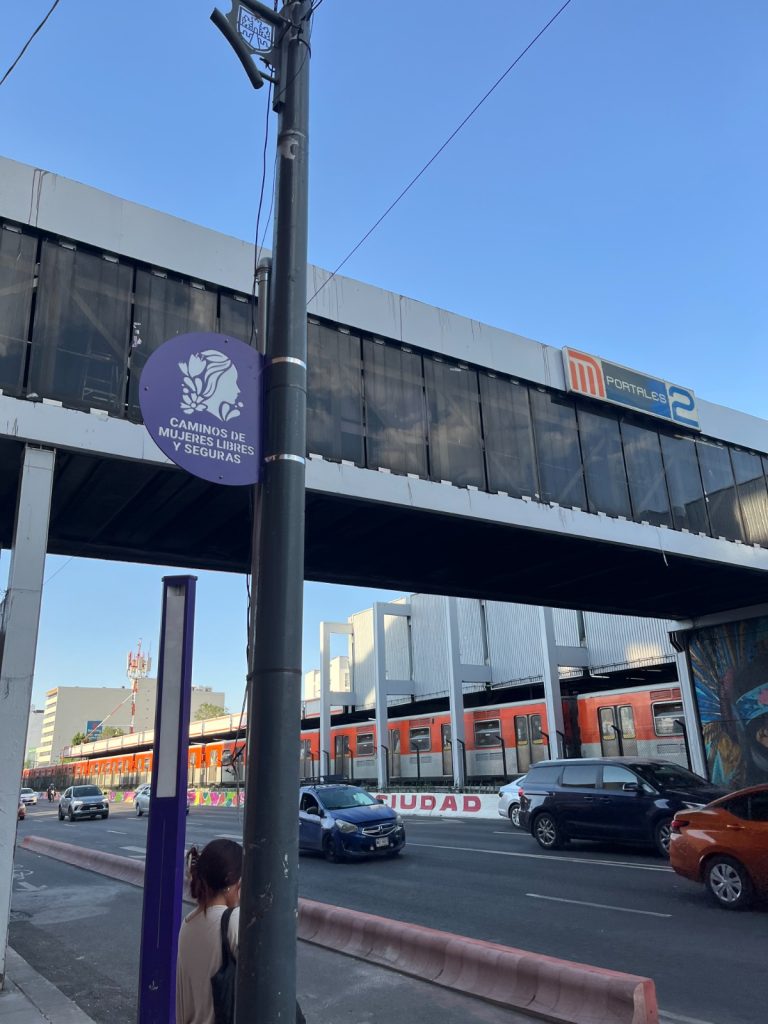
One of the main thoroughfares, La Calzada de Tlalpan—which leads to Azteca Stadium, where several World Cup matches are played—has also undergone major upgrades, including newly paved sidewalks, bike lanes, and purple lampposts and curbs.
Feminism as branding
“This is feminism,” said one of my Mexican friends. “What,” I said, “how is painting something purple feminism?”
He was referring to the initiatives to make the city more women-friendly: Mexico City’s public transportation system has long had designated zones for women to reduce sexual harassment.
In public spaces, measures such as dedicated phone numbers and SOS buttons are in place. And along Calzada de Tlalpan, in addition to freshly painted railings, curbs, and purple lampposts, signs have been erected explaining that these indicate safe and secure walking paths for women.
Mexico elected its first female president in 2024, Claudia Sheinbaum, who represents the left-wing Morena party. Sheinbaum has distinguished herself by taking a firm stance against U.S. President Trump and by advocating for women’s rights.
Mexico also launched a feminist foreign policy in 2020, at the time becoming the first country from the Global South to do so. Mexico’s feminist foreign policy focuses on gender equality, human rights, and an intersectional approach—where various forms of discrimination, such as those based on gender, class, ethnicity, and sexuality, are viewed in context—in its diplomatic efforts.
Branding related to feminism and gender equality also helps distinguish the Mexican government from the Trump administration in its neighboring country.
Women’s rights in Mexico
Although Mexico has had a feminist foreign policy since 2020, it is unclear what has been achieved and what this policy entails in practice.
Mexican feminists and activists are not always impressed by the government’s policies. They question the extent to which the government’s policies address the security needs of various groups, including female activists and women who are victims of violence.
Violence against women is a big problem in Mexico. Femicide refers to the murder of women and girls simply because they are women, often motivated by misogyny, contempt, or a sense of ownership. In Mexico, there are about ten such murders per day. The work for women’s rights therefore addresses deep-seated and increasingly visible social challenges and demands.
The country also faces major challenges related to disappearances and missing persons; according to international sources, there are over 100,000 missing persons in Mexico.
Madres buscadoras, or “searching mothers,” are Mexican female activists who are searching for their missing loved ones or their remains. They have often faced hostility and threats from the state and other groups, and some have themselves gone missing or been killed.
Vulnerable groups faced with football-feminism
La Calzada de Tlalpan is also known for the many sex workers who gather along this road to offer their services. Recently, the road has been partially closed due to protests.
Some of these protests have involved sex workers who claim they are being driven from their workplaces because of all the improvements in the area. They are particularly upset about the new bike lanes being built, which they believe prevent them from doing their work and earning a living. Many sex workers are breadwinners who use the income from sex work to cover household expenses.
Many believe that some of the resources being spent on giving the city a facelift for the World Cup could have been used to improve conditions for vulnerable groups.
Internal security challenges in the run-up to the World Cup
When the leader of the Jalisco New Generation Cartel (JNG) was killed in a military operation in February of this year, media reported on the alarming security situation ahead of the World Cup. But cartels can be bought off, and by all accounts, the Mexican government has plenty of experience with that.
Ideologically motivated terrorism, however, is another story, which makes the recent attack at one of Mexico’s most important tourist attractions more concerning. On April 20 of this year, a Canadian tourist was shot and killed, and 13 others were injured, when an armed man opened fire on tourists in Teotihuacan, an archaeological site known for its large pyramids and a popular tourist attraction just outside Mexico City.
We have since learned that the perpetrator was a 27-year-old man from Mexico City. He is said to have been inspired by the 1999 Columbine High School massacre in the United States and is reported to have shouted hostile remarks against Europeans and foreigners during the attack, which ended with him taking his own life.
These events are likely causing great concern for Mexican authorities in a country that has relatively little experience with ideologically motivated terrorism, which is something we’ve seen more of in countries like the United States. The focus on feminism and women’s rights can thus be seen as a smart and much-needed positive focus.
So what about feminism?
So what about this branding related to football and feminism? If the World Cup can be used to draw a little extra attention to women’s rights, isn’t that a good thing?
Or should we focus on superficial measures and the lack of more profound changes that would improve conditions for women and other vulnerable groups? Is it possible to use feminism for political gain while also achieving meaningful change?
Time will tell whether feminist branding and politics will have more lasting consequences for women’s rights in Mexico. In the meantime, Mexico is gearing up for several weeks of the World Cup. And if I know Mexicans well, it’s going to be a real fiesta.
*Cover image: An advertising poster with the text “The Capital of Soccer and Feminism” at a subway station in Mexico City. Photo: Jenny Lorentzen